Closings tell you what already happened. They don’t always tell you where an agent began to stall.
The earlier signals often show up in logged activity, progress against plan, missed commitments, and changes in an agent’s pulse. If you can see those signals together, you can start the right conversation before a deal, or a client relationship, is at risk.
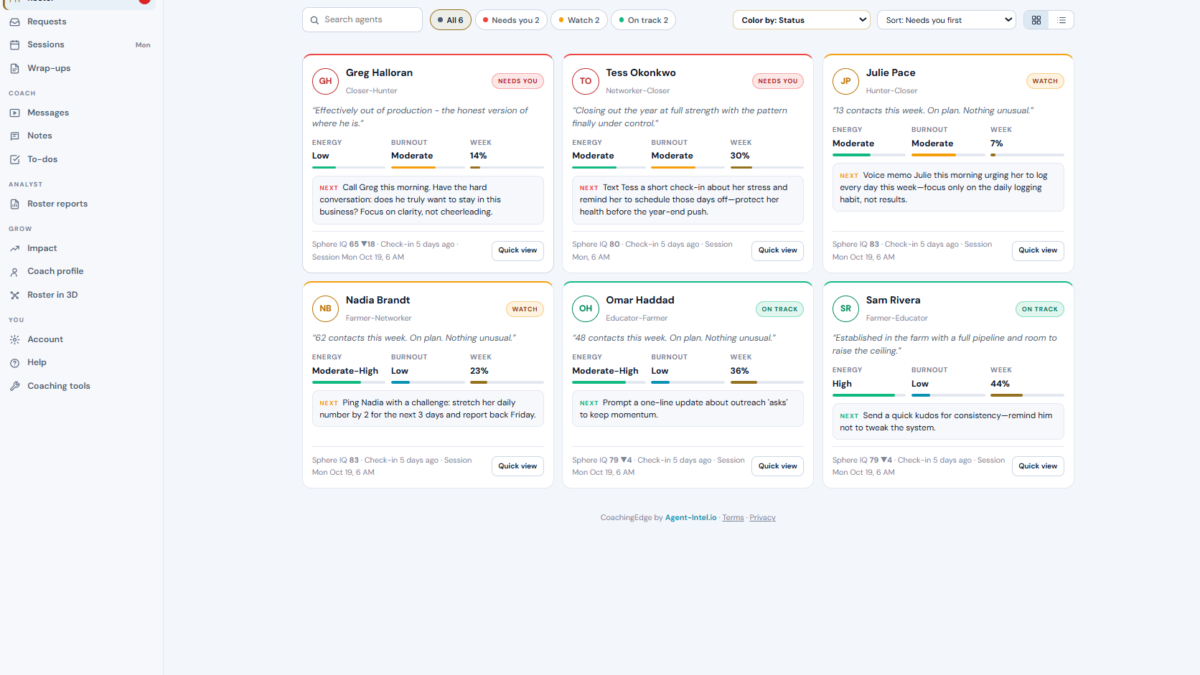
CoachingEdge gives you a whole-roster brief, flags agents who are slipping or stalled, and prepares a session brief before your one-on-one. It’s real estate team management software built to make coaching more prepared and accountability more specific, not to replace your judgment.
Start with the pattern, not the closing
One quiet week isn’t proof that an agent is in trouble. Neither is one missed task. The useful signal is a pattern: activity falling behind plan, commitments not showing up in logged data, or wellness and pulse changing alongside the numbers.
Those indicators don’t tell you the full story. They tell you where to look and what to ask.
CoachingEdge reads agents’ real logged activity, wellness or pulse inputs, and plan-versus-actual progress. It brings the roster into one brief and flags agents who may need your attention. You see a reason to check in, not a verdict about someone’s ability or effort.
That distinction matters. A stalled agent might need a clearer priority, a skills conversation, a workload check, or a direct discussion about follow-through. You need evidence before you choose the intervention.

What to look for this morning
Start with exceptions. Don’t spend your first hour reviewing every agent equally.
Check for a combination of signals:
- Activity behind plan: Logged daily activity isn’t keeping pace with the agent’s plan.
- Commitments without follow-through: A prior session set actions, but recent logged activity doesn’t show evidence they were completed.
- Pulse changes: An agent’s check-in signals a shift in energy, motivation, confidence, or stress.
- Repeated slippage: The same gap appears across review periods instead of resolving after one check-in.
These signals are prompts for a conversation, not automatic explanations. A gap in logged activity doesn’t prove that no work happened. Ask what’s missing, confirm the context, and agree on the next step.
That’s the difference between accountability and guesswork. A useful sales accountability software workflow connects what was planned, what was logged, and what you discuss next.
Diagnose before you prescribe
Before telling an agent to “make more calls” or “get back on track,” identify the gap.
Is the issue activity against plan? Did a previous commitment remain incomplete? Has the agent’s pulse changed? Or do you need more information before you can tell?
A coaching conversation should be specific, fair, and grounded in the available record. Try:
“Your recent activity is behind your plan, and the commitment from our last session isn’t showing in the log. What got in the way? Let’s agree on one next action and when you’ll complete it.”
Then listen. The data gets you to the right question. The conversation gives you the context. Your job is to leave with an action you can review, not a vague promise to “do better.”
Walk into the one-on-one prepared
CoachingEdge prepares an AI session briefing before a one-on-one. The brief brings together the agent’s recent logged activity, plan-versus-actual progress, wellness or pulse, and what happened in the last session. You can review the relevant context before the meeting rather than spending the opening minutes trying to reconstruct it.
A Coach Session Brief includes:
- A recap of the last session
- Follow-through on previous commitments
- Suggested topics for the conversation
- A conversation opener
- A quick win to recognize
- What to avoid today
- An archetype tip

The brief is preparation, not a script. You bring the judgment. The system helps you arrive with a starting point grounded in the agent’s own data.
That makes the session more useful for both sides. You can recognize a real win without ignoring an overdue commitment. You can address a slip without treating one rough period as the agent’s whole story. And you can leave with a clear next focus.
Track the session pulse
Performance and wellbeing belong in the same coaching conversation. An agent’s activity may be slipping while energy remains steady, or the numbers may change alongside a reported increase in stress. Those are different situations, and they call for different questions.
CoachingEdge tracks session pulse, including before-and-after check-ins. You can review what the agent reported before and after a session and see whether the conversation shifted their stated energy, motivation, confidence, or stress. Those ratings don’t prove that a coaching session caused a change. They give you a concrete input to discuss and follow over time.

After the session, set the next commitment clearly. Then check the logged activity before the next conversation. If the commitment is still incomplete, don’t restart from zero. Ask what happened, decide whether the plan needs to change, and record the next action.
Use one roster view to decide who needs you
When you lead a team, the risk isn’t only missing a signal. It’s having to search across multiple records to find it.
CoachingEdge gives you a read-only dashboard for agents you coach and monitors the roster in one brief. You can see who’s flagged and who’s on track, then open an agent’s view for more context. The dashboard is read-only; it supports your coaching work rather than silently changing an agent’s records.
The point isn’t to watch every move. It’s to direct your attention where the pattern says a conversation may be useful, and avoid unnecessary check-ins when an agent is on track.
General sales-management guidance makes a similar distinction: pipeline risk is easier to address when managers can spot warning signals before they become outcomes. See Gartner’s guidance on pinpointing pipeline risks. CoachingEdge applies that practical idea to your roster using the agent data logged in the platform.
Keep the next action measurable
A weak coaching close sounds like: “Try to be more consistent.”
A useful close names the commitment, the deadline, and what you’ll review. For example: agree on one specific activity to complete by Friday, then check the relevant logged activity at the next session. Don’t assign more work than the agent can reasonably act on. Don’t leave the session without a clear follow-up.
If the agreed action doesn’t happen, the record gives you a starting point for the next discussion. If it does, you can recognize the follow-through. Either way, accountability becomes more than a memory of what you think you said.
What the software does, and doesn’t do
CoachingEdge organizes the signals and prepares your sessions. It does not know the full story behind a missed commitment, replace your judgment, or turn a flag into a diagnosis. Logged information is useful evidence, but context still matters.
Your coaching remains yours. The platform helps you see the pattern, prepare the question, and return to the commitment.
Pricing and next step
CoachingEdge starts at $354 per month for one lead and five agents. That includes the coach platform, five AgentEdge seats, roster-level daily briefing, AI session preparation, and session tracking with before-and-after pulse. That works out to $70.80 per agent, with the coach seat included.
There’s also a lead-plus-10-agent package at $590 per month. No annual contract or setup fee. See the CoachingEdge plans and details.
Start with one question: Which agent’s pattern deserves your attention today? Review the brief, prepare the conversation, and agree on one next action before the session ends.