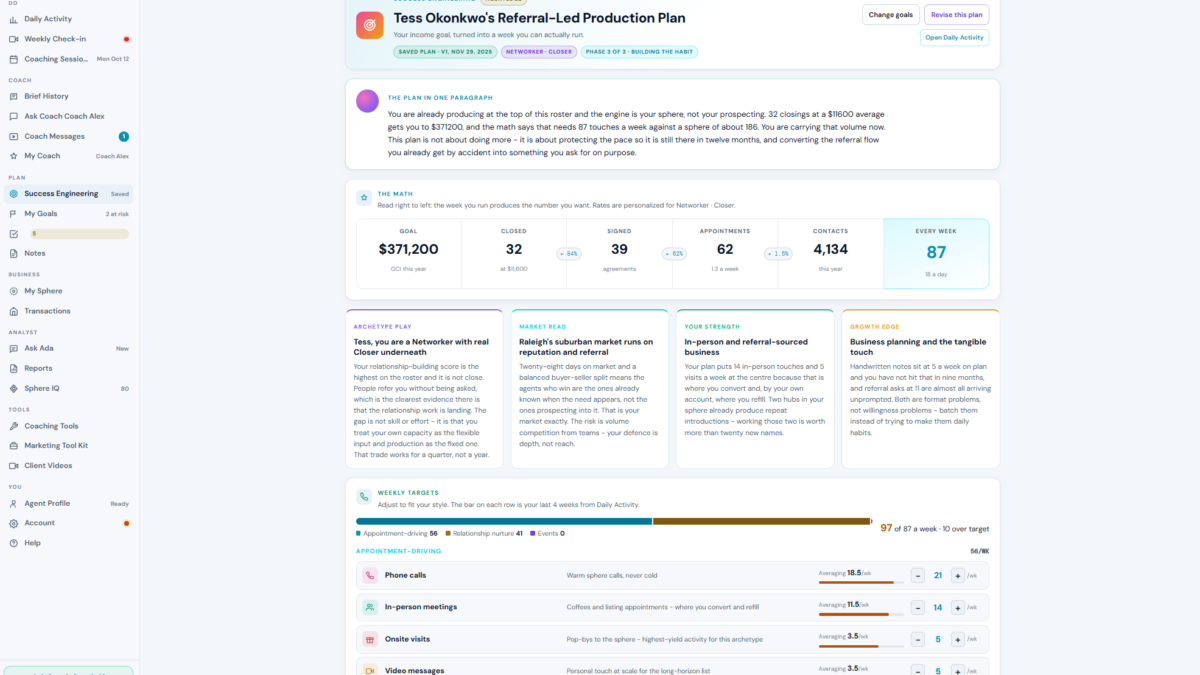
A revenue target is not a plan. “I want to earn $250,000” doesn’t tell you who to call this morning, how many appointments to book, or whether your current activity can produce the result.
A useful plan works backward. It connects your income goal to the deals, clients, appointments, and conversations you need, then puts the next action on this week’s calendar.
Here’s a worked example. The numbers are assumptions for illustration, not universal conversion benchmarks. Your own history should replace them as you track results. In the live plan, the engine starts from default conversion rates of 70% client-to-close, 50% appointment-to-client, and 10% conversation-touch-to-appointment, then calibrates them from your own observed data each quarter when the sample is strong enough.
Start with the number that matters
First, define your goal. This example uses $250,000 in gross commission income (GCI): before brokerage splits, expenses, and taxes.
Next, calculate your average GCI per closed side. Use your actual production records, not a market headline.
Let’s assume you average $10,000 GCI per closing:
- $250,000 GCI goal ÷ $10,000 per closing = 25 closed sides
That’s the outcome. Now work backward to the activity that can support it.
Work backward through the funnel
For this example, assume the platform’s default starting rates:
- 70% of signed clients close
- 50% of appointments become signed clients
- 10% of meaningful conversations lead to an appointment
Apply those rates in reverse:
- Closed sides: 25
- Signed clients needed: 25 ÷ 70% = 35.7, so plan for 36
- Appointments needed: 36 ÷ 50% = 72
- Meaningful conversations: 72 ÷ 10% = 720
To leave room for two weeks away from production, spread the target across 50 working weeks:
| Weekly measure | Approximate target |
|---|---|
| Meaningful conversations | 14–15 |
| Appointments | 1–2 |
| Signed clients | About 1 |
| Closed sides | About 0.5 |
A closing won’t land every week. The point is to build a steady pipeline that averages about 25 closings across the year.
Be precise about what you count. A dial is an attempt; a meaningful conversation is an actual exchange. If 30% of your outreach attempts become conversations, about 14–15 meaningful conversations require roughly 50 attempts a week, about 10 a day across five workdays.
That is a starting model, not a promise. If your own conversion rates differ, your activity targets should differ too.
Make the plan fit your business
One inherited curriculum can’t account for your price point, database, local market, or lead sources. A real estate coaching app should connect the math to your actual business, not hand you a generic call quota.
Your market affects the plan in concrete ways. If your average GCI per closing is $8,000 instead of $10,000, a $250,000 goal takes about 32 closings, not 25. If your signed-client-to-close rate is lower, you need more signed clients to reach the same outcome.
Your sphere matters, too. The plan should tell you the required sphere size your goal needs, not just report how many contacts you already have. At about 14–15 meaningful conversations a week for 50 weeks, you’re aiming for roughly 720 conversations a year. That doesn’t mean dividing your time evenly across every name. Prioritize people based on relationship, history, timing, and the kind of business they’re likely to refer.
The activity mix should fit how you work:
- Hunter: Make room for direct prospecting, then build follow-up so new contacts don’t disappear.
- Farmer: Protect consistent nurture, but measure real conversations, not just marketing activity.
- Networker: Use your relationships and events, and set a clear referral-ask target.
- Educator: Turn useful expertise into conversations; don’t let one more edit delay the next post or seminar.
- Closer: Keep appointments coming. A strong conversion rate doesn’t help if the pipeline is empty.
AgentEdge assigns a primary and secondary archetype pair through a five-minute video profile assessment—for example, Networker · Closer—with an archetype confidence percentage. The result helps shape the activity mix without changing the income math.
Track the week, not just the goal
A plan only helps if you compare it with what actually happened. Log your attempts and conversations separately, along with appointments, sphere touches, and the actions you completed. Then you can see where the funnel is slipping.

If you made 50 attempts but had only 8 meaningful conversations, the issue isn’t necessarily effort. Your reach rate may be below the assumption. If you had 15 conversations but set no appointments, review the conversation-to-appointment step. The diagnosis changes the next action.
That’s why volume alone isn’t progress. Fifty attempts show output. Appointments, signed clients, and closings show whether the output is moving your goal.
Adjust the plan as the numbers change
Each week, compare your actuals with your targets. Look for missed commitments, falling conversion rates, or a shrinking pipeline, not just whether you were busy.

The Monday Read gives you a weekly view of activity and follow-up priorities. Use it to ask: Did your conversations produce appointments? Are important contacts overdue? Which assumption needs updating?
If your measured conversation-to-appointment rate comes in at 8% instead of the 10% default, the original plan is too light. If your average GCI rises, you may need fewer closings. When your goal, deal size, conversion rates, or sphere changes, regenerate the plan. Don’t keep following last quarter’s math.
What the five-minute plan gives you
AgentEdge Success Engineering connects your income target to average deal size, required closings, clients, appointment targets, required sphere size, and weekly contact activity. It uses your profile and production information to turn the goal into a working plan, then gives you a daily brief with the priorities to act on.
It isn’t a motivational quote or a list of generic prospecting ideas. It’s a route from your target to today’s work, and the weekly numbers that show whether the route is holding.
For team leads, CoachingEdge applies the same kind of plan across a roster, with a view of who is on track, slipping, or stalled and preparation for coaching sessions.
AgentEdge costs $59 per month, with a 7-day free trial, 20 chat credits, and the printable day sheet included, with no setup fee or annual contract. Cancel anytime. CoachingEdge starts at $354 per month for a lead plus five agents. See AgentEdge to review the product.
Set your income goal. Check your actual conversion rates. Then identify the first activity you need to complete today.