Draft for Robert’s review, not approved for publication.
Your best agent can be on track in the production report and already feel unsupported. By the time you hear they’re considering a move, the real issue may have been building for weeks: stress rising, commitments slipping, and no useful conversation about what’s getting in the way.
Compensation matters. But it isn’t the only factor. A peer-reviewed study of real estate agents found that burnout, organizational recognition, and communication climate were linked to turnover intention. Recent brokerage reporting also points to leadership, support, development, and culture, not sales alone.
The practical question for you: What changes in an agent’s work before they tell you they’re unhappy?
Early signals worth a conversation
No single status tells you an agent plans to leave. A quiet week isn’t a verdict. A missed commitment isn’t a diagnosis.
Look for changes against that agent’s own pattern, and ask what they mean.
- Energy, motivation, or confidence shifts. Stress rises, or a check-in sounds notably different from the last one.
- Activity stalls or slips. Logged work falls behind the agent’s plan, goals become at risk, or the weekly pace changes.
- Follow-through weakens. A commitment from a coaching session isn’t reflected in the agent’s logged activity.
- One-on-ones lose focus. You spend the session catching up on what happened instead of addressing the issue that matters now.
- You only see production. The numbers show output, but they don’t tell you how the agent is doing or what support they need.
Treat these as prompts, not proof. Data can help you notice a change. The conversation establishes what is happening.
Notice strain before the next session
An agent can keep producing while stress climbs. If you review production alone, you miss that distinction.
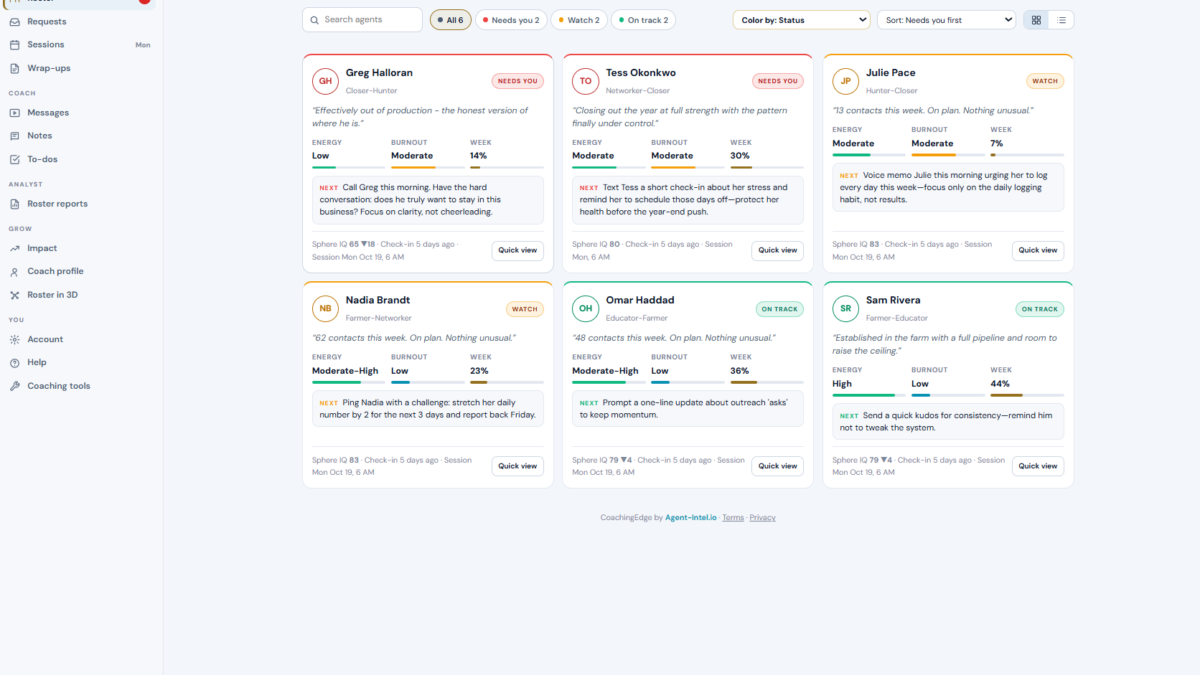
CoachingEdge brings connected agents’ daily activity, goals, wellness pulse, and weekly video check-ins into your coaching view. Weekly check-ins are analyzed for sentiment, energy, confidence, motivation, and burnout signals. Daily wellness pulse data adds another view of energy, motivation, and stress over time.
That gives you a concrete place to start, not a generic “How’s everything?” and not a diagnosis.
Your move: ask about the change. If the signals show stress rising, begin with capacity and support before you push for more output.

See who needs you this morning
When you manage a roster, you can’t hold every agent’s recent activity, check-ins, goals, and commitments in your head. A spreadsheet may tell you who is behind. It rarely prepares you for what to do next.
CoachingEdge builds an overnight coach brief from agents’ check-ins, activity, and goals. In the roster, status labels such as Needs you, Watch, and On track help you focus attention. Agent cards provide context such as energy, burnout indicators, week pace, and a suggested next action.
That’s the useful distinction in real estate team management software: not another screen to inspect, but a prioritized view that helps you decide who to contact and why.
Use the flags as a starting point, not a label to apply without checking. Reach out, ask what has changed, and agree on the next action together. The brief helps you prepare; you still lead the conversation.

Walk into one-on-ones prepared
A weak session starts with you asking for an update the agent has already given elsewhere. A better one starts with the information that matters.
Before a session, CoachingEdge prepares an AI briefing using the agent’s check-in, recent activity, and prior session context. It summarizes how the agent is showing up, identifies topics to raise, and suggests an opening. It can also surface whether an earlier commitment appears off track, so you can ask what happened rather than assume why.
For example:
This week: Activity is behind plan. Stress is up, while motivation and confidence have fallen since the last check-in.
Open with: “You said the week felt harder. What’s taking the most energy right now?”
Then clarify: Which commitment still matters, and what support would make it realistic?
That’s sales coaching software doing the preparation, not replacing your judgment. The session still depends on listening, asking directly, and agreeing on a workable next step.

Measure the session, then follow through
A good conversation can feel productive and still leave no clear commitment. CoachingEdge records session steps, including pre- and post-session check-ins. Agents can report energy, motivation, confidence, stress, and overall state before and after a session.
Session commitments can be tracked against the agent’s logged activity, so you can review what was kept, missed, or remains unfinished. Use that record to start the next conversation with evidence, not a vague recollection.
If a commitment was missed, don’t fill in the reason yourself. Ask. Was the target unclear? Did the agent’s priorities change? Was the plan too ambitious? Reset the action and agree when you’ll revisit it.
The point isn’t to score someone’s feelings. It’s to make coaching specific, visible, and accountable.

Keep visibility useful and bounded
Coaching data only helps if agents understand what you can see. CoachingEdge provides a read-only view of connected agent information for coaching. The product also distinguishes shared information from private notes and to-dos; private agent items are excluded from the coach-facing view.
Set the expectation before an agent joins: explain what information supports coaching, what remains private, and how you’ll use the signals. A roster status should trigger a supportive check-in, not a surprise confrontation. A wellness pattern is a reason to ask, not an automatic conclusion about someone’s health or intent.
If you want to keep a strong agent, make the data useful to them too. Bring the relevant pattern into the conversation, agree on one action, and follow up when you said you would.
A practical weekly routine
Use the tools to make a consistent coaching rhythm easier to keep:
- Before your day starts: Review the roster brief and choose who needs a conversation today.
- Before each one-on-one: Read the session briefing. Identify the open question and the commitment to revisit.
- After the session: Record the wrap-up and confirm the agreed action.
- At the next check-in: Compare what changed with what the agent said they would do.
No dashboard can guarantee an agent will stay. But a repeatable process gives you a better chance of noticing a change early, and responding before the only conversation left is an exit interview.
CoachingEdge pricing
CoachingEdge costs $354/month for a lead plus five agents or $590/month for a lead plus ten agents. There’s no setup fee and no annual contract.
Review the Agent Intel website or start an account to choose a configuration.
[PLACEHOLDER, DO NOT PUBLISH AS IS: NEW COACHINGEDGE RETENTION FEATURES]
[Fill in only after the new retention features have launched and are documented in the product bible. Add verified feature descriptions, the specific inputs each feature uses, what the coach sees, and any important limitations. Confirm live status and approved wording with Robert before publishing.]