You have two broad ways to improve your real estate business:
- Work with a traditional human coach.
- Use AI sales coaching software that reviews your activity and gives you daily direction.
Both can work. Neither fixes weak follow-through by itself.
The right choice depends on your budget, team size, need for personal support, and willingness to work from your actual numbers. Traditional real estate coaching brings judgment, experience, and conversation. AI coaching brings frequency, consistency, and data-driven recommendations.
The strongest model for many agents is not either-or. It is human strategy supported by daily AI accountability.
The short answer
Traditional real estate coaching is usually better when you need:
- Complex deal strategy.
- Market-specific judgment.
- Emotional support from an experienced professional.
- Role-play, relationship building, and direct challenge.
- A coach who can adapt in real time to a difficult situation.
AI sales coaching is usually better when you need:
- Daily accountability.
- Lower-cost access to structured coaching.
- Recommendations based on your logged activity.
- Consistent follow-up with your sphere.
- A clear brief before you start work.
- Early warnings about slipping performance or burnout.
The difference is simple: traditional coaching gives you a scheduled conversation. AI coaching gives you an operating rhythm.
Traditional real estate coaching: where it works
A good human coach can see what a dashboard cannot.
They can challenge your assumptions, ask why you keep avoiding a certain prospecting task, and help you navigate a complicated client or negotiation. They can also bring lived experience from running a real estate business.
That matters. Real estate remains a relationship business. Judgment, trust, timing, and local context are difficult to reduce to a score.
Traditional coaching is especially useful when you need to:
- Build a prospecting process from scratch.
- Improve your confidence in live conversations.
- Prepare for a difficult listing or buyer consultation.
- Review a major business decision.
- Work through a personal or professional setback.
- Develop leadership skills as a broker or team lead.
The weakness is consistency.
Your coaching may happen weekly, twice monthly, or monthly. If the session moves, accountability moves with it. A coach may also rely on what you remember to report instead of what your activity records show.
Cost is another factor. A HousingWire interview described individual real estate coaching at around $2,000 per month, although prices vary widely by coach, program, access, and contract. Some programs also include annual commitments, setup fees, group tiers, or paid add-ons.
Human coaching can be high value. It can also be difficult to scale across a full roster.
AI sales coaching: where it works
AI sales coaching software works from the evidence already produced by your business.
It can review activity, goals, touch history, progress, and pulse data. It can identify a pattern you missed because you were busy closing, chasing leads, or preparing your next listing.
The value is frequency.
A daily brief can tell you:
- Who is overdue for contact.
- Which activity is above target but producing no appointments.
- Whether your income goal matches your current pipeline.
- What commitment you missed yesterday.
- Which action deserves attention first this morning.
That is different from opening a chatbot and asking, “How do I get more listings?”
A generic chatbot gives you options. A real estate coaching app should narrow the options to one useful next action.

Personalization: generic advice versus your numbers

Traditional coaching can be highly personal, but the quality depends on the coach’s preparation and access to your records.
AI coaching starts with a different advantage: it can apply the same review every day without relying on memory.
AgentEdge uses your:
- Archetype and skill profile.
- Income target.
- Logged activity.
- Database and sphere.
- Days since each contact was touched.
- Goals and weekly commitments.
- Daily energy, motivation, confidence, focus, and stress.
- Video check-in signals.
The output changes as your data changes.
For example, producing 37 contacts in a week may look strong. But if those contacts are mostly low-priority names while your top referral sources remain untouched, volume is hiding the real problem.
The diagnosis comes first: all width, zero depth.
The prescription follows: contact three overdue high-value relationships before you do anything else.
That is what data-driven personalization looks like. Not a motivational quote. Not a menu full of tasks you will never open.
Daily accountability versus monthly review

Most agents do not need more information. They need the first action identified before the workday gets noisy.
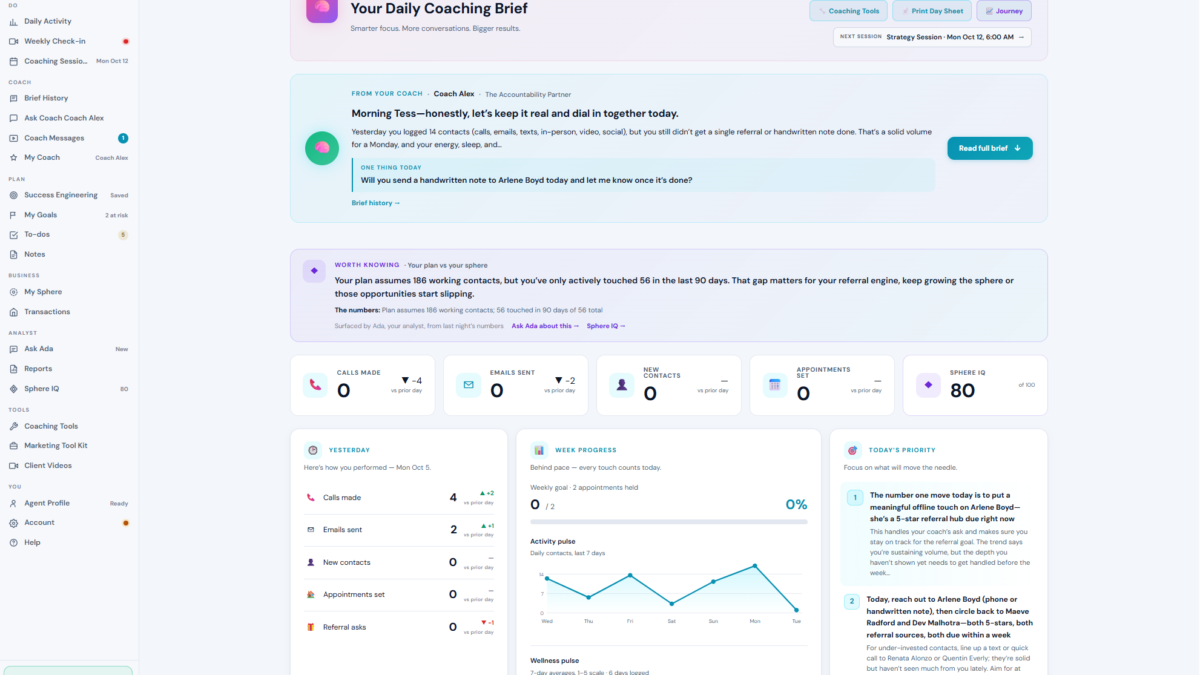
AgentEdge generates a daily coaching brief before 8 AM. It reviews your prior activity, current targets, database touchpoints, and personal signals. You start the day with:
- Yesterday’s performance.
- Week progress.
- Today’s priority.
- Recommended sphere touches.
- Activity targets.
- A self-care or wellness observation.
- One question you need to answer.
The system does not wait until the end of the month to tell you that your pipeline is weak.
If you miss a commitment, the next brief records it. If your activity increases but appointments remain at zero, the gap becomes visible. If your energy drops across several days, that becomes part of the coaching context.
No dodges. The pattern is in the data.
Success engineering: connect income to activity

A revenue target is not a plan.
“Earn $200,000 this year” becomes useful only when you know the required number of conversations, appointments, clients, and closings.
AgentEdge uses success engineering to reverse-engineer your income goal into weekly activities. It connects:
- Income target.
- Average deal size.
- Required closings.
- Required clients.
- Appointment targets.
- Required sphere size.
- Weekly contact activity.
The plan also accounts for how you work best.
A Hunter may need a different activity mix from a Farmer. A Networker may need a direct referral ask. An Educator may need a publishing deadline tied to a conversation. A Closer may need more top-of-funnel activity before the next opportunity appears.
AgentEdge identifies a primary and secondary archetype pair through a five-minute video profile assessment, with a confidence percentage attached to the result:
- Hunter.
- Farmer.
- Networker.
- Educator.
- Closer.
Your archetype describes how you naturally work and shapes the activity mix without changing the income math. If you retake the assessment, the new profile replaces the old one.
Wellness and burnout: the part most coaching skips

Performance is not separate from energy.
If your motivation, confidence, focus, and stress are deteriorating, your activity plan may become unrealistic. You may still log contacts, but the quality of your conversations and follow-through can decline.
AgentEdge tracks daily pulse and wellness data. Weekly video check-ins review sentiment and burnout signals.
This is not therapy. It is operational context.
The system may show that your activity is technically on target while your energy has been weak for four straight days. The next action may be to simplify the day, protect a focused call block, or address the overdue priority before adding more tasks.
Human coaches are often better at providing empathy and nuanced support. AI is better at noticing repeated changes and surfacing them consistently.
Use both strengths correctly.
What about brokers and team leads?
Individual coaching does not solve roster visibility.
If you lead a team, you need to know who is progressing, who is stalled, and which conversation requires your attention before the session begins.
CoachingEdge gives coaches, brokers, and team leads:
- One daily AI brief across the roster.
- Red flags for slipping or stalled agents.
- Session preparation before each conversation.
- Read-only dashboards for each agent.
- Before-and-after session pulse tracking.
- Notes and video messages for follow-up.

The coach keeps the relationship. The engine prepares the conversation.
That changes the manager’s job. Instead of asking every agent for an update, you can open with the actual gap:
“You are at 112% of your contact target, but your appointment conversion has fallen for three weeks. What changed?”
That is a better coaching conversation than “How is everything going?”
Cost comparison
Traditional coaching costs vary significantly. You may pay for:
- One-to-one sessions.
- Group coaching.
- Certification or onboarding.
- Annual contracts.
- Setup fees.
- Separate team or accountability programs.
AgentEdge takes a simpler approach:
- $59 per month.
- No annual contract.
- No setup fee.
- Cancel anytime.
- Daily coaching brief, success engineering, profile assessment, check-ins, sphere recommendations, and pulse tracking included.
Optional marketing tools are separate:
- AgentEdge+ adds marketing and content tools for $20 per month.
- AgentEdge Pro adds client intelligence for $40 per month.
For teams, CoachingEdge starts at:
- $354 per month for a lead plus five agents.
- $590 per month for a lead plus ten agents.
See the Agent Intel platform for the current configuration and signup options.
Which option fits your business?
Use this checklist.
Choose traditional real estate coaching if:
- You need hands-on strategy for complex situations.
- You learn best through live conversation.
- You want deep role-play and direct human feedback.
- You have the budget for recurring coaching.
- You will attend sessions consistently and bring accurate numbers.
Choose AI sales coaching if:
- You need direction every morning.
- Your follow-up is inconsistent.
- Your database contains overdue contacts.
- You want coaching based on logged activity, not memory.
- You need a lower-cost option without an annual commitment.
- You want wellness and burnout signals included in performance reviews.
Choose a hybrid model if:
- You want daily accountability plus human judgment.
- You lead a team and need better session preparation.
- Your coach has limited time for routine monitoring.
- You want to reserve human sessions for high-value problems.
- You need consistent measurement across every agent.
The practical conclusion
Traditional coaching is not obsolete. It remains valuable for judgment, trust, strategy, and difficult conversations.
But a monthly call cannot replace daily preparation.
AI sales coaching is the better fit when your main problem is inconsistency, weak follow-through, unclear priorities, or expensive access to support. AgentEdge gives you a one-page brief before work begins, built from your goals, activity, database, archetype, and current state.
Start with the diagnosis:
- What did you commit to last week?
- What did you actually complete?
- Which relationship is overdue?
- What activity is creating conversations?
- What are you avoiding this morning?
Then take the first recommended action before 9 AM. Your next brief will reflect what happened.